Table Of Content
[1] The nonequivalent comparison group design looks a lot like the classic experimental design, except it does not use random assignment. Perhaps the treatment group has a characteristic that is unique–for example, higher income or different diagnoses–that make the treatment more effective. Quasi-experimental designs have a comparison group that is similar to a control group except assignment to the comparison group is not determined by random assignment. The nonequivalent comparison group design looks a lot like the classic experimental design, except it does not use random assignment. While this method is more convenient for real-world research, it is less likely that that the groups are comparable than if they had been determined by random assignment. Researchers who conduct hypothesis testing in vivo animal work should understand the importance of limiting the impact of experimental biases in the design, conduct, analysis and reporting of in vivo experiments.
Static-Group Comparison
A nearby sign informed customers that if the sales clerk did not ask them, they would get a lottery ticket for free. Observed differences between the two groups are assumed to be a result of the treatment. The team lead decides one group of employees to get the soft skills training while the other group remains as a control group and is not exposed to any program. He then compares both the groups and finds out the treatment group has evolved in their soft skills more than the control group.
You are unable to access scribbr.com
(PDF) Examining the effectiveness of Technology use by Educators to improve students' Test Scores: A Quasi ... - ResearchGate
(PDF) Examining the effectiveness of Technology use by Educators to improve students' Test Scores: A Quasi ....
Posted: Sat, 06 Jun 2020 04:44:50 GMT [source]
Through this semistructured process, they were able to identify trends in expert opinion, as well as rank the trends to help inform public policy. Due to such working, static-group comparison design is generally perceived as a quasi-experimental design too. Randomization is important in an experimental research because it ensures unbiased results of the experiment. By creating a research design, a researcher is also giving oneself time to organize the research, set up relevant boundaries for the study, and increase the reliability of the results.
Characteristics of Pre-experimental Designs
What we cannot say is if this change would have occurred even without the application of the treatment or independent variable. It is possible that mere maturation caused the change in grades and not the work experience itself. To illustrate, the Federal Communications Commission (FCC) allowed television broadcasting to be introduced for the first time in several medium-sized cities in the United States in 1951. Bans on indoor smoking have been introduced in numerous cities (and states) on specific dates. If outcome data can be collected or archival data are available at regular fixed intervals (e.g., weekly, monthly), the ITS provides a strong design for causal inference. The logic of the ITS closely parallels that of the RD design except that the threshold on the time rather than the baseline covariate is the basis for treatment assignment (Reichardt, 2006).
Pooling refers to consultation with decision makers who have dealt with the problem of obesity in a similar population or setting. At this point, they should turn to the opinions of experts and experienced practitioners in their or similar settings (e.g., Banwell et al., 2005; D’Onofrio, 2001). Methods exist for pooling these opinions and analyzing them in various systematic and formal or unsystematic and informal ways. For example, Banwell and colleagues (2005) used an adapted Delphi technique (the Delphi Method, described in Chapter 6) to obtain views of obesity, dietary, and physical activity experts about social trends that have contributed to an obesogenic environment in Australia.
Industry-leading experience.
This sums up the basics of pre-experimental design and how it differs from other experimental research designs. Curious to learn how you can use survey software to conduct your experimental research, book a meeting with us. The pre-experimental design includes one or more than one experimental groups to be observed against certain treatments. It is the simplest form of research design that follows the basic steps in experiments. To publish significant results, choosing a quality research design forms the foundation to build the research study. Moreover, effective research design helps establish quality decision-making procedures, structures the research to lead to easier data analysis, and addresses the main research question.
2: Pre-experimental and quasi-experimental design
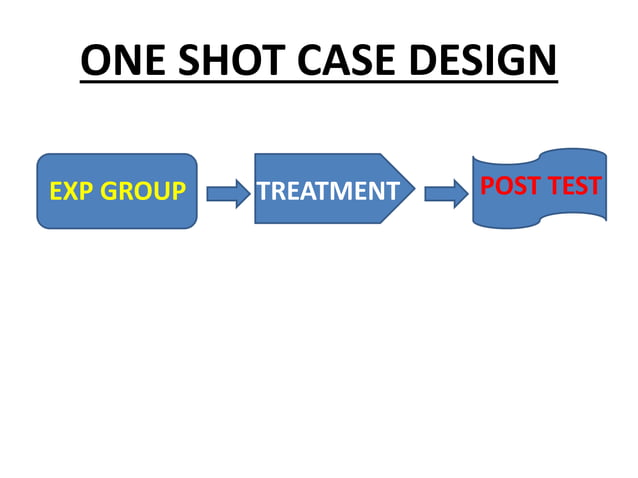
In this instance, pre- and posttests are both taken, but there is no control group to which to compare the experimental group. Because there is no pretest and no comparison group, this design is not useful for supporting causality since we can’t establish time order and we can’t control for extraneous variables. Sometimes, agencies need to gather information about how their programs are functioning. A classic example of this design is satisfaction surveys—realistically, these can only be administered after a program or intervention. Questions regarding satisfaction, ease of use or engagement, or other questions that don’t involve comparisons are best suited for this type of design. Also known as a before-after one-group design, this type of research design does not have a comparison group; everyone who participates in the research receives the intervention or is exposed to the experimental condition (Figure 14.8).
Ideally, these protocols should be preregistered and/or published, so that the methods which will be used to reduce the impact of bias are documented in an a priori fashion. The process of peer review of a protocol prior to initiating experiments of course is a valuable opportunity for refinement and improvement. Registering protocols encourages rigour and transparency, even if the protocol is not peer-reviewed. Some journals are open to submissions of these types of protocols, such as BMJ Open Science, and many journals offer the Registered Reports format.
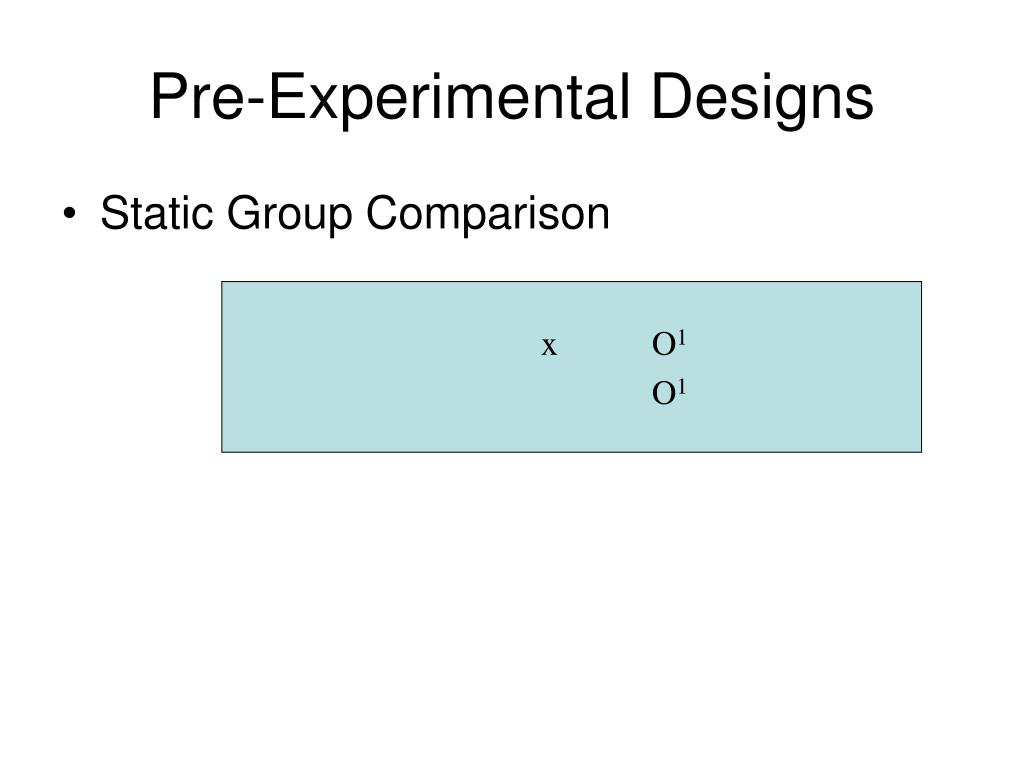
Static-group comparison
An example of an ecological model that illustrates the matching process is the Multilevel Approach to Community Health (MATCH) model of B. The MATCH model suggests the alignment of evidence with each of the four levels shown by the vertical arrangement of boxes in the figure. Finally, if a researcher is unlikely to be able to identify a sample large enough to split into multiple groups, or if he or she simply doesn’t have access to a control group, the researcher might use a one-group pre-/posttest design. In this instance, pre- and posttests are both taken but, as stated, there is no control group to which to compare the experimental group. We might be able to study of the impact of Hurricane Katrina using this design if we’d been collecting data on the impacted communities prior to the hurricane. Without having collected data from impacted communities prior to the hurricane, we would be unable to employ a one-group pre-/posttest design to study Hurricane Katrina’s impact.
Differences in breadth will be reflected in choices of the population(s) covered (e.g., defined by age, gender, race/ethnicity, socioeconomic status), the range of diseases considered, and the types of costs to include. These decisions will be driven by the perspective taken in the study, as well as by available data. In a static-group comparison, there are two groups that are not created through random assignment. One group receives the treatment and the other does not, and the outcomes are compared.
Imagine if the students in your research class completed a questionnaire about their level of stress at the beginning of the semester. If there was a comparison group, she would be able to recognize that all students experienced higher stress at the end of the semester than the beginning of the semester, not just the students in her research class. Mapping refers to tracing the causal chains or mechanisms of change inferred when evidence is matched with levels of intervention and change. The evidence will be incomplete at each ecological level with respect to the local or state circumstances in which a decision and action must be taken, but theory can (and will, formally or informally, consciously or unconsciously) be brought to bear.
Consequently, they are often used as stepping stones towards more rigorous research designs. As such, understanding pre-experimental designs is a fundamental part of the researcher’s toolkit, paving the way for more comprehensive and controlled investigations. Let’s say all the above parameters work just in favor of your experiment, you even have a control group to compare it with, but that still leaves us with one problem. It is possible that the subjects in your pre-experimental design were a lot different from the subjects you have for the true experiment. If this is the case, even if your treatment is constant, there is still going to be a change in your results. In this section, we will describe the major domains, in other words, sources that could contribute to experimental bias if not carefully considered and if mitigating tactics are not included in the design of hypothesis testing experiments before data collection starts.
The Plant Design Studio is an industry pioneer with more than fifteen years of focused experience creating beautiful single-family and multifamily homes exclusively for prefabricated construction. Our team has designed more than 40 residential projects, earning some of the industry’s top honors. You should anticipate and incorporate those limitations into your conclusion, as well as the basic research design. Include a statement in your manuscript about any perceived limitations, and how you considered them while designing your experiment and drawing the conclusion.
It begins with researchers thinking about what variables are important in their study, particularly demographic variables or attributes that might impact their dependent variable. Then, the matched pair is split—with one participant going to the experimental group and the other to the comparison group. An ex post facto control group, in contrast, is when a researcher matches individuals after the intervention is administered to some participants. Finally, researchers may engage in aggregate matching, in which the comparison group is determined to be similar on important variables. Social welfare policy researchers often look for what are termed natural experiments, or situations in which comparable groups are created by differences that already occur in the real world. Natural experiments are a feature of the social world that allows researchers to use the logic of experimental design to investigate the connection between variables.
Ludwig and Miller (2007) used this design to study some of the educational and health effects of the implementation of the original Head Start program in 1965. When the program was launched, counties were invited to submit applications for Head Start funding. In a special program, the 300 poorest counties in the United States (poverty rates exceeding a threshold of 59.2 percent) received technical assistance in writing the Head Start grant proposal. Because of the technical assistance intervention, a very high proportion (80 percent) of the poorest counties received funding, approximately twice the rate of slightly better-off counties (49.2 percent to 59.2 percent poverty rates) that did not receive this assistance.


No comments:
Post a Comment